VMG Blog Pages

Showing posts with label file sharing. Show all posts

Friday, December 19, 2008

RIAA Announces Plan to End Lawsuits

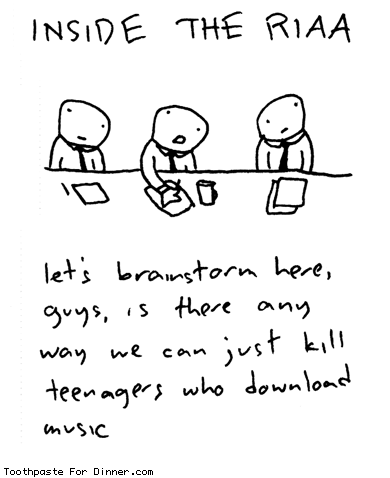
After years of suing thousands of people for allegedly stealing music via the Internet, the recording industry is set to drop its legal assault as it searches for more effective ways to combat online music piracy.

The decision represents an abrupt shift of strategy for the industry, which has opened legal proceedings against about 35,000 people since 2003. Critics say the legal offensive ultimately did little to stem the tide of illegally downloaded music. And it created a public-relations disaster for the industry, whose lawsuits targeted, among others, several single mothers, a dead person and a 13-year-old girl.

Instead, the Recording Industry Association of America said it plans to try an approach that relies on the cooperation of Internet-service providers. The trade group said it has hashed out preliminary agreements with major ISPs under which it will send an email to the provider when it finds a provider's customers making music available online for others to take.


I'm not sure if this is good news or not. While I'm glad to hear that they aren't planning on suing anyone besides heavy file sharers, I think it's bad for internet users in general. Having the RIAA team up with ISP's in an effort to stem copyright infringement opens the door for the RIAA to become even more heavy handed by circumventing the courts all together. Look how long it took for someone to actually take the RIAA to full trial. Only then did their tactics unravel and the holes in their plans become obvious. 

I think, as many others do, that letting the ISP's become content police is horrible. Should the US Postal Service be allowed to open the mail of people who have a high volume of mail? Should the postal service be inspecting every package to make sure people aren't sending anything illegal. Just because a package weighs 2.2 pounds, doesn't mean it's likely a kilo of cocaine or heroin. It certainly wouldn't be sufficient grounds for a search. 

Another question that comes to mind is why would the ISP's want this role? What's in it for them? Perhaps they envision enough of a drop in traffic (from throttling bit torrent etc) where they could further put off investing money into infrastructure that can handle the huge increase in traffic created by video, voip and file-sharing. 

The more likely scenario is that it's easier to play ball with the RIAA than it is to defend a huge lawsuit that challenges the "safe harbour" laws that protect them. One would think that the ISP's would want to remain neutral and not have the added expense of filtering and throttling. It seems like the RIAA is trying to put the ISP's directly in the crosshairs of consumer ire. Any way you look at it, this can't be a good deal for the ISP's bottom line.

Monday, August 04, 2008

Judge Hints at Mistrial in RIAA v. Jammie Thomas

The federal judge who presided over the nation's only peer-to-peer copyright-infringement trial announced from the bench here Monday that he is likely to declare a mistrial.

"Certainly, I have sent a signal to both sides of where I'm headed," U.S. District Judge Michael Davis said during a 70-minute hearing in which lawyers for the Recording Industry Association of America and defendant Jammie Thomas sparred over whether a jury verdict against Thomas should be overturned.
At issue is whether the RIAA needs to prove that copyrighted music offered by a defendant on a peer-to-peer network was actually downloaded by anyone. During Thomas' trial last October, Davis, on the RIAA's recommendation, instructed (.pdf) the jury that no such proof was necessary; if Thomas had the music in her Kazaa shared folder, where it could be downloaded, she could be found liable "regardless of whether actual distribution has been shown."

But in May, long after Thomas had lost the trial and was dinged $222,000, Davis developed second thoughts. He wrote in an order that he may have committed a "manifest error" with that instruction. "I think I surprised everyone," Davis said at the outset of the Monday's hearing. As the hearing wrapped up, there was little evidence that the RIAA's lawyer had changed the judge's mind.

Judge Hints at Mistrial in RIAA v. Jammie Thomas

At this point I will pause to pat myself on the back. I was asking this very question about "availability" being the same as distribution about three years ago. As I've said before, it will be a painful lesson for the RIAA/MPAA goon squad to learn. There's no winning when one tries to pull the wool over the collective eyes of Judges accross the country. The manner in which they slid in the jury instructions regarding availability was underhanded and surely didn't go unnoticed.

Thursday, May 15, 2008

Judge Says RIAA's "Making Available" Argument is Bullshit!

The act of making music available online may not be a copyright violation after all. And if that's the case, Jammie Thomas of Minnesota may not have to pay the $222,000 judgment won by record companies last year, an amount Thomas' attorneys argue is unconstitutionally excessive.

In his blog on Thursday, Google senior copyright counsel William Patry wrote, "Today, district judge Michael Davis issued an order indicating he may order a new trial based on an entirely different ground: concern that Jury Instruction N. 15, which permitted the jury to find infringement based on the RIAA's making available theory, may be contrary to the Eighth Circuit's binding precedent in National Car Rental System, Inc. v. Computer Associates Inc., requiring the distribution of actual copies."

RIAA Setback: Making Music Available May Not Be Copyright Infringement

I've never been able to get my little pea-brain around the "making available" argument. It simply goes against everything our system stands for. I mean, come on, we live in a country where "if the glove doesn't fit..then you must aquitt." pretty well sums up our judicial philosophy. If you can't prove that someone actually broke a law by a preponderence of the evidence you simply have no case. So, I could never understand how the "making available" theory passed the smell test.
As I've stated in previous posts, I think the RIAA's shady tactics are starting to unravel. You can be sure this won't be the last ruling that doesn't go the RIAA's way. My limited courtroom experience tells me that the Judiciary doesn't like to have the wool pulled over its eyes and like an elephant, it never forgets. The days of the RIAA lawyers sliding shoddy legal practices by Judges are numbered. It will be amusing to watch as they go down in flames right before our eyes. I'm pretty sure I won't be shedding any tears...unless they are accompanied by some serious belly laughs. As a wise man once said, "Fuck the RIAA!"

Saturday, March 22, 2008

Torrent Freak Kicks Ass!

If I had a mouthful of milk right now it would be shooting out my nose as I laugh my ass off. The great folks at Torrent Freak have pulled off a fine piece of "journalism" on this one. As I was reading this story with great interest, it dawned on me ...I was reading a very nice list of the best places to get torrents!
The way the story was presented, it struck me at first as a educational and well presented look at the state of torrent traffic and an informative overall piece. In fact it really is. Very nice work guys! Its a "twofer"....

BitTorrent Sites Show Explosive Growth - TorrentFreak

Monday, March 17, 2008

Amended Complaint Filed In RIAA/Media Sentry Lawsuit

Tanya Andersen has filed her amended complaint in her class action, Andersen v. Atlantic.The 109-page document provides a detailed description of some of the RIAA abuses, and contains 18 claims for relief, including Federal and State RICO claims, negligence, intentional infliction of emotional distress, abuse of process, and fraud.The suit targets the record companies, MediaSentry, Settlement Support Center LLC, and the RIAA.The complaint begins:

1.1 For nearly three years of her life, Tanya Andersen and her young daughter were subjected to an outrageous series of baseless accusations and unrelenting threats of financial ruin. The world’s four major recording studios had devised an illegal enterprise intent on maintaining their virtually complete monopoly over the distribution of recorded music. The enterprise is conducted with total disregard for innocent individuals. Dead people have been sued. Children have been sued. People without computers have been sued. As a senior RIAA spokeswoman explained: “When you fish with a net, you are going to catch a few dolphins”. By their own early admission, they were knowingly engaged in a “driftnet fishing” operation and “innocent dolphins” were the collateral damage in their “nets”.

Nationwide Conspiracy of Crime 1.2 -In 2003 and before, the Big 4 recording companies conspired with the enforcement/lobbying arm of the music cartel -- the RIAA -- and MediaSentry to devise an investigation scheme that was both illegal and seriously flawed. The scheme was based on secret private investigations by unlicensed, unregistered and uncertified private investigators. These private investigators claim to have illegally entered the hard drives of tens of thousands of private American citizens to look for music recordings stored there. This personal invasion is a crime in virtually every state in the country. If music was “discovered” through this illegal process, the private investigators would then sell the identity of the computers’ internet protocol address to the RIAA and the Big 4 record companies.

You can follow this story and more at the Recording Industry vs The People website. If you are into reading all the gory legal details of the RIAA lawsuit witch-hunt, this is the best place to do it. While it can be a bit dry at times, it will give you excellent insight into the legal arguments presented by both sides of the debate. If you pay close attention, you can gain some insight into how to stay out of the sights of the RIAA/Media Sentry folks.

For instance, one of the common themes I've seen is the majority of these cases involve Kazaa users. Does anyone even use this crappy client anymore? If you do, I suggest you find a better alternative and/or educate yourself on how other dumbass people are getting caught!

Tuesday, February 26, 2008

MIT Panel Trashes Comcast's Network Management

CAMBRIDGE, Mass.--Comcast has confessed to slowing down certain peer-to-peer file-sharing traffic, but is it being clear enough about what it's doing?
That's perhaps the key question that emerged by the end of a lengthy public forum convened by the Federal Communications Commission on Monday here at Harvard Law School.
While none of the FCC commissioners was willing to solidify an answer to that just yet, two MIT computer scientists on an afternoon panel accused the cable company of behaving badly on multiple levels.


As most readers of this blog know by now, I am in full support of net neutrality. While one has to understand the concept of the need to "manage" network traffic, it is incredibly naive to think even for a second that how to do this should be left to the sole discretion of the ISP's. The internet has flourished thus far as a communication medium that is unfettered by government interference. The ISP's were exstatic that they now had a whole new revenue stream to tap into and they gladly made the investment necessary to profit greatly from it.
With the advent of VOIP, video, bit torrent etc..., the internet has outgrown it's infancy stage and has reached the point of being a young adolesent. The ISP's should have seen this coming when the net was in its toddler stage, but they chose to favor immediate profits over long term viability. They've now come to a point where the existing infrastructure can't keep up with the demand needed for today's services. The ISP's seem to want to punish the consumer for their bad business choices. This stone age mentality seems to mirror the strategy of one of my other "favorite" subjects, the RIAA. Businesses that are unwilling to change, because they refuse to make necessary investments, should not be coddled by the government or further supported by the public.

Saturday, February 02, 2008

Whoops—Italy inadvertently legalizes some P2P music

The Italian parliament has passed a new copyright law that would decriminalize the sharing of "degraded" music on the Internet for educational and scientific purposes. Apparently, lawmakers didn't realize that 256kbps MP3s are degraded.

Read more from ARS Technica

Digg This Story

I thought the intent of this law was an interesting concept. What they are trying to say is that an mp3 is not the same as sharing the original quality commercial release. Therefore there is no infringement. Of course, here in the states, this concept would never get any legs as it is clearly in violation of the DMCA which covers reproduction of a copyrighted material in any form.

Sunday, January 27, 2008

No way! The MPAA Wouldn't Lie to Anyone...

For two years, the film industry has relied on an erroneous figure to persuade the public that college students are thieves. The MPAA acknowledged Tuesday that a survey it released in 2005 overstated the damage caused by piracy at the nation's universities. The MPAA now says that instead of 44 percent, students account for 15 percent of domestic losses.


Why did colleges stay mum on MPAA stats? Tech news blog - CNET News.com

I must say that I am shocked (NOT!) that the folks from the MPAA would exagerrate their claims. I think this report is probably only the tip of the iceberg. I bet if one were to look at the tactics of the RIAA/MPAA more closely, you would find that exaggeration and exploitation of data and revenue losses are at the heart of most all the arguments they make. For example, they claim huge numbers when describing their "losses" because of file sharing. The reality is that a large number of people, when asked, wouldn't buy the narrow, crappy entertainment they offer. It's frequently overpriced and overvalued. While many might check out the junk they offer for free, they simply aren't willing to shell out their hard earned entertainment dollars on it. Again, if you ask the file sharing community, many of them are willing to purchase the content they find appealing to them or at least are willing to use ad supported content. The point to be made here is this:

Just because someone consumes content over a P2P network, it doesn't mean that they would be a paying consumer.

With this being said, all of the claims of huge losses by the industry are hogwash. This concept isn't hard to grasp. What's hard to believe is that the politicians in Washington are taking this crap hook, line and sinker. The reality is that the industry is dying a slow painful death due to their unwillingness to embrace the digital age they helped to create in the first place. The lobbyists are working hard to convince lawmakers that they are being victimized by file sharing. The only thing they are being victimized by is their own stupidity for clinging to an outdated business model.

Thursday, January 24, 2008

Comcast’s BitTorrent Throttling Acceptable? Not Quite!

Comcast, and other ISPs advertise with certain upload and download rates, conforming to simple DOCSIS capacity numbers. However, they miscalculated and found that there is more to the Internet than browsing, gopher, and email. Heavy-users broke their excel return-on-investment predictions and marketing campaign promises. Their flat-rate offers simply became too popular for the capacity that was bought and installed.

Comcast’s BitTorrent Throttling Acceptable? Not Quite! TorrentFreak

This really echoes the point I've been making for a couple of years now. Charter also uses bandwidth throttling to cheat us of the bandwidth we pay for. I think a class-action lawsuit is an appropriate response to this practice. There is no other way to describe it, other than simple fraud.

Saturday, January 19, 2008

Europe Embraces Decriminalizing File Sharing

The message put forward by the parties is pretty strong: “Whenever you rent a movie, the multinational media industry forces you to watch their propaganda. They claim that downloading movies is the same as snatching bags, stealing cars or shoplifting. That’s simply not true – making a copy is fundamentally different from stealing.”


European Politicians Launch Pro-Filesharing Campaign


I'm not sure that this movement is going to gain any traction in the US anytime soon. I like the fact that Europeans are open minded and recognize the flaws in the RIAA/MPAA approach to combating piracy. The "The Genie is Out of the Bottle" line of thinking makes a lot more sense than the "Let's Punish the End-User Approach". I've never seen an industry as a whole adopt an approach that believes alienating the consumer will improve the almighty bottom line. The closest analogy I can think of is the automobile industry. There was a time when, your car needed repair, you were required (By the Big 3) to bring it back to the dealership or void your warranty. This tactic was used to eliminate the little guy by forbidding the consumer to bring their vehicle to the repair shop of their choosing. You would hear these crazy stories of people who were denied legitimate warranty service because they had their tires or wipers changed elsewhere. When the imports became a serious challenge to the Big 3, they were forced to drop this ludicrous position.

Until the consumers revolt and some company comes along with a more reasonable policy, these chucleheads at the RIAA/MPAA will continue to alienate the very people to which they are trying to suck the entertainment dollar from....